Monday, November 30, 2015

minute mysteries

I learned about this super fun "game" (I suppose you could call it) from my friend! The name, "minute mysteries," is very misleading because some take a second and some take, like, an HOUR!

Just type in "minute mysteries" on your computer (but be warned, some can be rather...violent). You wanna do one?

First, you read off of whatever website you're using the mystery. (NOTE: This involves two people.)

I'll be the person reading it, and you be the "detective."

MYSTERY:

Joe leaves his house, wearing a mask and carrying an empty sack. An hour later, he returns. The sack is now full. He goes into a room and turns out the lights.

The "detective" now asks yes or no questions. The reader, who is the only one who has read will answer the questions, often with the response: It is irrelevant. 

How about you start asking questions?

YOU: Is something dangerous inside the sack?

ME: Nope.

YOU: Is Joe bad? [Most of the mysteries are pretty violent, so don't be surprised by the questions.]

ME: Nope.

YOU: Is the "an hour later" part important?

ME: No, but it can lead you to the answer slightly. Slightly.

YOU: Why is he wearing a mask?

ME: Yes or no questions.

YOU: Uh...

ME: Want a clue?

YOU: Yeah, sure!

ME: The day is important.

YOU: Is it a Sunday?

ME: That is irrelevant.

YOU: Is it a holiday?

ME: Yes!

YOU: Is it an important or widely celebrated holiday?

ME: Yes!

YOU: Is it Christmas?

ME: No...

YOU: Thanksgiving?

ME: No...

YOU: Halloween?

ME: YES!

YOU: Is Joe a kid who is trick-or-treating? 

ME: You got it!

THE ACTUAL ANSWER, WHICH I SAW BEFOREHAND:

Joe is a kid who goes trick-or-treating.

Fun, right?! You can also play with a big group, everyone guessing and one reader answering all the questions. 

Once I found one that said:

MYSTERY:

A woman walks up to a door and knocks. Another woman inside answers the door. The woman outside kills the woman inside.

MYSTERY SOLVED:

The woman outside is a psychotic librarian. The woman inside has an extremely overdue book. 

Weird, huh? Some are super detailed and tell a full-on story about two guys on an island...

A minute-mystery expert,

-Avamae 

Friday, November 20, 2015

The Back Stitch/Pekinese Stitch

The back stitch is an EXTREMELY commonly used stitch. It is perfect for letters, borders, anything! The back stitch also creates a thin line great for details. The Pekinese stitch is a back stitch with a supplement.

To begin the back stitch, make a stitch about 1/4 inch long (sorry about the shadows - the lighting was pretty terrible).


Enter 1/4 inches away from the end of the first stitch.


Exit at the end of the previous stitch.


Reenter at the end of the last stitch, and redo the last four steps.


This is the completed back stitch.


Now for the Pekinese Stitch - a surface stitch.

First, enter either right under or right over the first back stitch.


Slide under the second stitch and tighten ever so slightly.


Enter from the top through the first stitch, under the floss, and tighten slightly.


Next, slide the needle under the third stitch. 


Enter through the second stitch, to the right of the last loop and under the floss. Continue doing this until your line is finished!

(I will upload the picture of the completed project later.)

-Ava......MAE!!!


Thursday, October 29, 2015

Orange Bullion Knot Rose

My friend Lauren completed an adorable orange rose as her second project. :D


The petals are made of bullion knots, the stem is embroidered with three layered stem stitches, and a fishbone stitch for the leaf. 

By the way, kudos to the determined Lauren - she used five different types of floss for the petals, and completing five trillion bullion knots is no easy task!!!!

Here is the close-up:

-Avamae...and Lauren!!!


Friday, October 2, 2015

Bible Book Cover

To keep you guys interested in my blog (which is gonna be pretty hard, seeing as I'm already BORING you to death with BORING posts about BORING stitches), I am gonna post about... drumroll please...

A BOOK COVER! How exciting, right? Anyhoozle, if you wanna make a bible book cover, or just a book cover for any book, you can...drumroll please...

LOOK UP DIY BOOK COVERS! 'Cause I am not gonna teach you. :( As I mentioned previously, you're probably BORED to death with BORING tutorials! (Here is the link to the diy version: http://makezine.com/2009/08/25/how-to_sew_a_simple_fabric_boo/ )

Here is the book cover...


For the "Holy" part, I couched a gold thread onto the turquoise fabric. I used the Split stitch for the "Bible," and I used the Back stitch for the "The." 

Here is the back side!


Happy stitching!

-Avamae


Sunday, September 27, 2015

Bullion Knot

The bullion knot is the hardest knot I know how to complete. It is absolutely beautiful for flowers (Look at the third pink blossom in http://www.avabethmae.blogspot.com/2015/06/three-large-embroidery-flowers.html) if you like them to pop out more, like French Knots.

First, enter 1/2 inch away from the beginning of the line.


Exit at the beginning of the line, but do not pull through.


Reenter where you began.


Point your needle where you exited in step 2 and twist the floss around it about ten or twelve times. (Sorry the pictures are so blurry!)


Pull your needle through, making sure to run your fingers up and down the working thread to make sure that there are no knots. (TIP: pull out the thread that is not the working thread)(the lazy thread)(quickly. It will make it much easier to pull through.)


Tighten.


Exit right under where your string protrudes.


Tighten.


To save thread, enter instead this time next to the right side of the previous bullion knot, and embroider it the opposite way. Honestly, you could have began at the beginning of the line the first time - it makes no difference.


To continue, go back and complete steps 1-8.


Here is the completed line of bullion knots.


-Avamae

Tuesday, September 15, 2015

Whipped Stem Stitch

The stem stitch is a commonly used stitch, great at creating curves or the stalks of flowers.

First, make a loop by exiting 1/4 inch away from where you entered, but do not pull the loop through.


Reenter through the middle of the loop, making sure that the loop is facing the same way each time.


Pull through.


Exit 1/4 inch away from the last stitch, but do not pull through.


Reenter where the last stitch ended, as shown:


Pull through.


If you are a more experienced embroiderer, try this technique (called the sewing method) to complete the stem stitch faster:


When you are at the end of the hoop, exit and pull through.


Here is the completed stem stitch.


Now, we can begin what I call "surface stitching" - stitching onto the finished stitch, rarely touching the fabric.

Enter on one side of the end of the stem stitch, and slide through the first stitch.


Pull through.


Slide through the second stitch the same way.


Continue looping around the stitches until you've reached the end. Exit next to the last stitch.


-Avamae
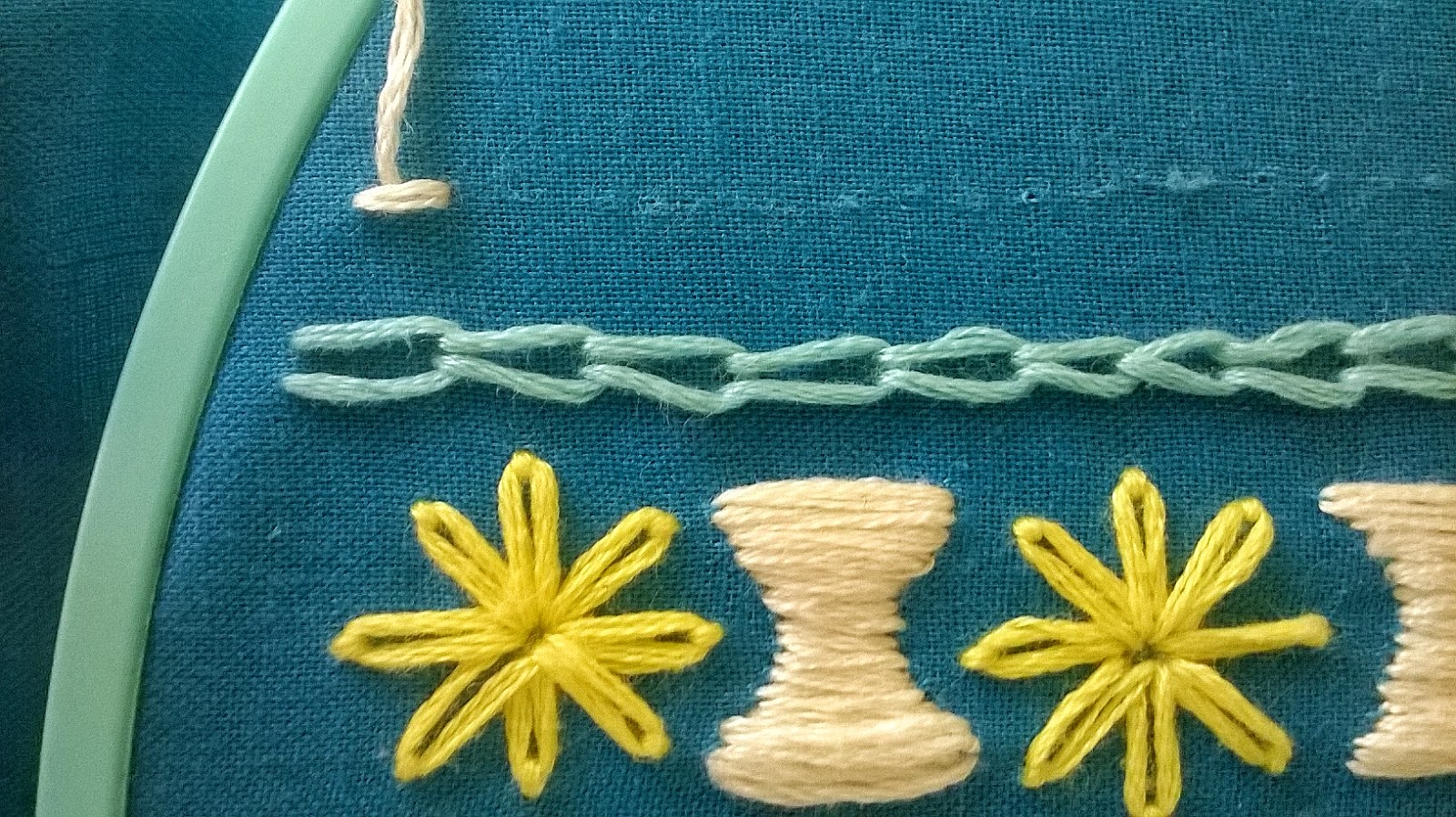
Saturday, September 12, 2015

Chain Stitch

The chain stitch is a variation of the blanket stitch, used as a border or even for filling.

First, make one line across your material with your fabric pencil. If you are a beginner, make two lines really close together.

Enter through the line with your threaded needle and pull through.


Exit right next to where you just entered, but do not pull through.


Reenter 1/2 cm to 1/4 inch away from your starting point, but still do not fully pull through.


OK, this gets kind of confusing, but stay with me! Reenter just like you did on the last loop - right next to where you entered, but do not pull through. Pinch the loop you just made and pull so the previous loop is taut.


Reenter 1/2 cm to 1/4 inch away from the first loop, exit a small space away, and pull the loop to tighten the last one.


Create and tighten these loops until you reach the end. Then, when you enter, do not exit and make another loop.


Make one more stitch on the other side of the loop to lock it in place.


Here is a picture of the finished chain stitch:


-Avamae